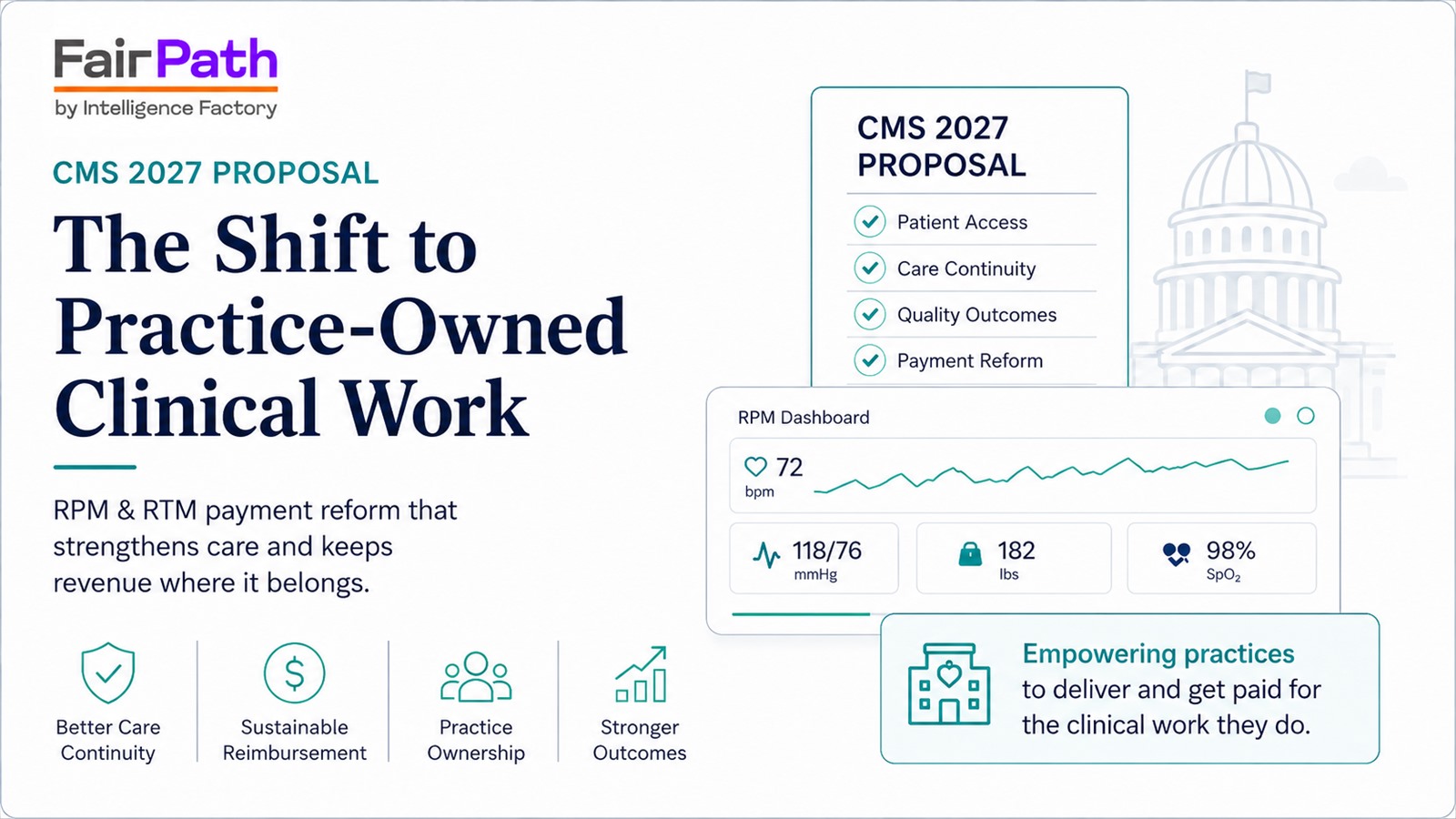
The CY 2027 Medicare Physician Fee Schedule proposed rule would limit billable remote patient monitoring (RPM) and remote therapeutic monitoring (RTM) clinical-staff work to direct employees of the billing practice. Here is what the rule says, why CMS proposed it, and what practices should do now, regardless of whether it is finalized as written.
The Rule
If contracted clinical staff run your RPM or RTM program today, CMS just proposed a rule that would end that arrangement for the billable clinical work it addresses beginning in 2027.
On July 14, 2026, CMS released the Calendar Year 2027 Medicare Physician Fee Schedule Proposed Rule (CMS-1848-P). It was published in the Federal Register on July 16. CMS proposes that, beginning January 1, 2027, Medicare payment for the RPM and RTM clinical-staff work addressed by the proposal would be allowed only when that work is performed by clinical staff who are direct employees of the billing practitioner or the practitioner's practice.
The requirement would apply only if the proposal is finalized.
CMS states in section II.D.(48)(d):
“We do not believe that RPM or RTM services provided by clinical staff contracted by a third party can ensure the billing practitioner has adequate oversight, management, or collaboration to bill RPM or RTM services.”
CMS continues:
“We are proposing to only allow payment for RPM or RTM services when furnished by clinical staff employed by the practice. To count the time spent by clinical staff providing aspects of RPM or RTM services, the clinical staff must be a direct employee of the practitioner or the practitioner's practice.”
The same section provides several important clarifications:
- Clinical staff do not need to be physically located in the practice.
- General supervision, rather than direct supervision, applies, provided the other “incident to” requirements at 42 CFR § 410.26 are met.
- The restriction addresses clinical staff furnishing RPM and RTM services and the clinical-staff time counted toward billing. It does not categorically prohibit third-party devices, software platforms, connectivity, logistics, or other non-clinical support.
The rule remains proposed. Comments are due September 14, 2026, and the proposed restriction does not change 2026 billing policy.
The employee requirement is only one part of CMS's remote-monitoring proposal. CMS also proposes a separately reportable initiating visit for RPM and RTM, an established-patient requirement for RTM, valuation updates based on potentially lower device costs, and possible bundling of 17 RPM and RTM CPT codes into four HCPCS G-codes. Those changes could also affect how practices structure and finance their programs.
Why CMS Is Moving in This Direction
CMS describes outsourced RPM and RTM arrangements in which staff communicate with beneficiaries by telephone or online despite having little established relationship with the beneficiary, the care team, the practice's office staff, or the billing practitioner.
CMS's stated concern is oversight: whether a billing practitioner can adequately manage and collaborate with contracted third-party clinical staff performing the work behind an RPM or RTM claim.
The proposal also arrives amid broader scrutiny of remote monitoring. In September 2024, HHS-OIG reported that about 43% of Medicare enrollees who received remote patient monitoring did not receive all three components of it, raising questions about whether RPM was being used as intended.
CMS says its proposed remote-monitoring changes would address recommendations from recent OIG reports. The agency does not identify the September 2024 report as the sole cause of the employee proposal, but the OIG finding provides important context for CMS's focus on complete services, practitioner oversight, and billing evidence.
What This Means for Practices
The shorthand “vendor ban” is imperfect. The proposal is narrower than a ban on all RPM and RTM vendors.
The operational consequence, however, is significant. If contracted third-party clinical staff currently perform the billable RPM or RTM work addressed by the proposal, the practice would need a different clinical staffing model if CMS finalizes the rule as written.
Practices could still use outside technology and operational support. Devices, software, connectivity, and non-clinical services are not categorically prohibited. The dividing line is between technology that supports the practice and contracted clinical staff who perform the work used to satisfy the billing requirements.
Practices that already employ the clinical team and control the workflow are structurally better aligned with the direction CMS is proposing.
What Practices Gain by Moving In-House
We have helped practices and pharmacies bring RPM and RTM programs in-house. We do not supply outsourced clinical staff. The practice employs the people delivering care, controls the clinical decisions, and maintains the patient relationship. FairPath provides the software, workflow structure, and AI support that make the operation manageable.
The reasons practices value the model are practical: they keep more of the money, control the work behind their claims, and keep the patient relationship with their own team.
They Keep More of the Money
In a percentage-based outsourced model, part of the program's collections goes to the clinical-services vendor. With FairPath's flat SaaS model, the practice keeps its collections and can use that revenue to support its own clinical staff and program operations.
FairPath estimates that combined APCM, RPM, and RTM programs can generate $250 to $350 per patient per month in reimbursement in certain scenarios, with modeled program costs of approximately $25 per patient per month, including software and device rental.
The financial structure is straightforward: the practice pays for technology rather than giving up a percentage of what the program collects. Reimbursement and costs vary by payer mix, panel composition, staffing, patient participation, and execution.
They Stop Outsourcing the Work Behind Their Claims
When a practice brings RPM and RTM in-house, its own employees review the data, contact patients, document the work, and follow the practice's escalation process. The practice can see who did the work, what was documented, and why the service is ready to bill.
That removes one of the biggest problems with outsourced clinical services: the practice no longer has to rely on a third party's staff, workflow, or documentation to support claims billed by the practitioner. The people responsible for the program can see the work as it happens and correct issues before billing.
This is exactly the concern CMS raised in the proposed rule. CMS questioned whether contracted third-party clinical staff give the billing practitioner adequate oversight, management, and collaboration. An in-house model puts that oversight back inside the practice.
They Build Better Patient Relationships
When the practice's own team runs RPM and RTM, remote care can remain connected to the relationship the patient already has with the practice.
The staff contacting the patient can work within the practice's clinical standards, communication style, and escalation process. The practice can shape outreach around its patient population instead of adapting care to an outside clinical-services vendor's standard workflow.
That continuity is one of the strongest reasons to own the program. RPM and RTM work best when they function as part of the patient's care, not as a separate service operating around it.
These are the outcomes practices value after moving in-house: more of the financial value stays in the practice, leadership controls the clinical work and billing evidence, and patients remain connected to the team responsible for their care.
What to Do Now
Practices do not need to predict the final rule before improving their operations.
- Map the current clinical workflow. Identify who reviews data, contacts patients, documents time, escalates concerns, and supports each claim.
- Separate technology from clinical labor. Software and devices may remain vendor-supported. The proposed restriction targets contracted clinical staff performing the billable work it addresses.
- Build visibility and evidence. Each claim should have a clear record of who performed the work, when it occurred, what was documented, and why the service was billed.
- Model an employment transition. If contracted vendor staff perform the clinical work, assess the staffing, training, supervision, workflow, and patient-continuity changes that would be required if CMS finalizes the proposal.
- Start with a focused panel. Establish a repeatable process with a manageable patient group, measure the results, and expand deliberately.
The practices best positioned for whatever CMS finalizes will be those that can demonstrate accountable, relationship-centered remote care supported by complete documentation.
The Bottom Line
CMS is proposing that the billing practitioner's team own the clinical work behind RPM and RTM services.
The policy is not final, but the underlying question is useful now: if the practice bills for the service, can it see and support the work behind the claim?
We have helped practices build programs in which their employees deliver the clinical care, their leadership controls the workflow, and their documentation stays connected to the services they bill. The practice retains its collections and patient relationships. FairPath supplies the technology and operational structure that make the model manageable.
Technology should make clinical ownership scalable, auditable, and efficient. It should not insert itself between the practice and the patient.
If contracted staff currently run your RPM or RTM program, let's map out what an in-house model looks like for your practice. No revenue share, no outsourced clinical staff, just the tools and structure for your team to run the program.
Sources and Disclosures
- CMS-1848-P, Federal Register, 91 FR 43892-43893, section II.D.(48)(d)
- CMS CY 2027 Medicare Physician Fee Schedule Proposed Rule Fact Sheet
- HHS-OIG OEI-02-23-00260, Additional Oversight of Remote Patient Monitoring in Medicare Is Needed
FairPath platform descriptions and economic examples are company-reported and have not been independently verified. Actual results vary by practice. Comments on the CMS proposal are due September 14, 2026. CMS is expected to issue the CY 2027 final rule later in 2026.